EPA Solicits Public Comment on Second Set of Scope Documents for Chemicals under TSCA

The US Environmental Protection Agency (EPA) released the second set of Scope Documents for chemicals undergoing risk evaluation under TSCA and is soliciting public comment. Those seven chemicals include:  Butyl benzyl phthalate,  Dibutyl phthalate, Dicyclohexyl phthalate, Di-ethylhexyl phthalate, Di-isobutyl phthalate, Formaldehyde, Phthalic anhydride. Links to these chemicals can be found at:  https://www.epa.gov/assessing-and-managing-chemicals-under-tsca/chemicals-undergoing-risk-evaluation-under-tsca.

New ToxStrategies Publication Compares the Threshold of Toxicological Concern (TTC) Values and Oral Reference Dose (RfD) Values

ToxStrategies’ scientists have proposed potential expansions of the use cases for the threshold of toxicological concern (TTC) in human health risk assessment applications. Analyses indicate that conservative TTC values for chemicals are, on average, approximately six-fold lower than IRIS derived reference dose (RfD) values for noncancer effects. The findings have three potential applications: (1) serve as provisional toxicity values estimated from TTC Cramer Classifications in data-poor or emergency situations, (2) serve as a comparator for toxicity criteria derived by multiple agencies or stakeholders, and (3) identify RfD values that might warrant reanalysis when they are substantially lower than their corresponding TTC value. Importantly, the findings reaffirm the health protective nature of TTC values, with the majority of TTC values being lower than their corresponding RfD values.

The open-access article was published in Regulatory Toxicology and Pharmacology.

ToxStrategies SOT 2020 E-Posters

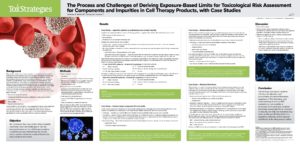
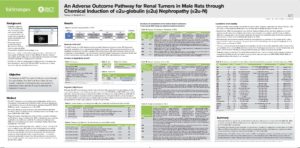
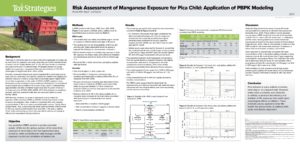
ToxStrategies scientists have the following e-posters available for viewing via the SOT Virtual Meeting Program.   Please click on the poster to view abstract and full poster.

Dr. Ali Chesney, lead author on The Process and Challenges of Deriving Exposure-Based Limits for Toxicological Risk Assessment for Components and Impurities Present in Cell Therapy Products with Case Studies

Dr. Allison Franzen, lead author on An Adverse Outcome Pathway for Renal Tumors in Male Rats through Chemical induction of α2u-globulin (α2u) Nephropathy (α2u-N)

Deborah Proctor, lead author on Risk Assessment of Manganese Exposure for Pica Child: Application of PBPK Modeling

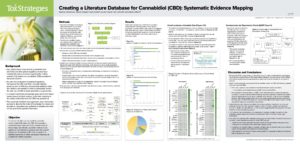
Dr. Rayetta Henderson, lead author on Creating a Literature Database for Cannabidiol (CBD): Systematic Evidence Mapping

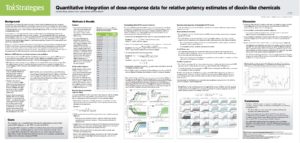
Dr. Caroline Ring, lead author on Quantitative integration of dose-response data for relative potency estimates of dioxin-like chemicals

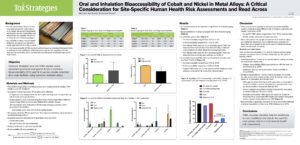
Mina Suh, lead author on Oral and Inhalation Bioaccessibility of Cobalt and Nickel in Metal Alloys: A Critical Consideration for Site-Specific Human Health Risk Assessments and Read Across

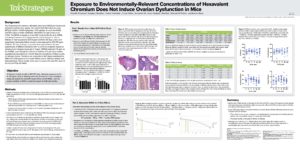
Dr. Chad Thompson, lead author on Exposure to Environmentally Relevant Concentrations of Hexavalent Chromium Do Not Induce Ovarian Dysfunction in Mice

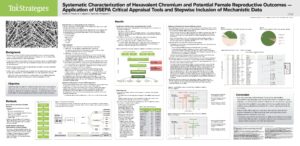
Dr. Daniele Wikoff, lead author on Systematic Characterization of Hexavalent Chromium and Potential Female Reproductive Outcomes – Application of US EPA Critical Appraisal Tools and Stepwise Inclusion of Mechanistic Data


Please follow us on Twitter and LinkedIn for our upcoming featured poster of the week.

How Do You Run a Clinical Trial in the Middle of a Pandemic?

This week, the US Food and Drug Administration (FDA) released guidance for sponsors conducting clinical trials on how to manage ongoing and planned activities. This guidance emphasizes patient safety and communication. FDA noted that the decisions about continuing with patient recruitment and treatment, implementing alternative options for patient monitoring or visits, or discontinuing a trial may depend on specific, individual circumstances. Changes or missing information with regard to COVID-19 should be well documented, and the clinical study report should describe contingency measures, a list of all participants affected, and the analyses and corresponding discussions that address the impact.

The complete guidance document can be found here.


New Opening for Scientist – Toxicologist/Pharmacologist

Job Description

ToxStrategies is seeking an experienced toxicologist/pharmacologist (minimum of 3 years in biopharmaceutical/pharmaceutical experience, in industry, government [FDA], or Contract Research Organizations [CROs]), to join our expanding Biopharmaceutical/Pharmaceutical consulting practice. ToxStrategies is a multidisciplinary scientific consulting firm that strives to develop innovative solutions to address the scientific, technical, and regulatory challenges confronting our clients. Scientists in our Biopharmaceutical/Pharmaceutical Practice provide consulting services to pharmaceutical companies in all phases of the drug development process. This includes providing clients with scientific, strategic, and regulatory expertise in the nonclinical safety assessment of biopharmaceutical/pharmaceutical products. This position requires understanding the scientific and regulatory process for the development of biopharmaceutical/pharmaceutical products for a variety of therapeutic indications.  The candidate must be familiar with current ICH and regulatory guidelines for drug development, as well as industry trends and new techniques and methods used in safety assessment studies.

This position will involve designing and overseeing nonclinical safety assessment programs for drug candidates, developing study protocols and reports, and interpreting data from various studies for the client and regulatory authorities. The candidate will be responsible for writing various regulatory documents (e.g., pre-IND packages, INDs/CTAs, BLAs/NDAs, Investigator Brochures), as well as risk assessments/monographs for drug components (e.g., impurities, solvents).  Within ToxStrategies you will work alongside toxicologists, epidemiologists, engineers, and biostatisticians who are recognized as leaders in their respective fields. This position offers a stimulating and challenging work environment, opportunities for professional development and leadership, and competitive compensation and benefits.

Responsibilities May Include:

  • Oversee the study design, data interpretation, and monitoring of toxicology studies in different animal species, and interpret and incorporate safety, TK/PK, and PK/PD data, and anti-drug antibody responses
  • Serve as the toxicology representative on project teams
  • Write pharmacology and toxicology sections of regulatory submissions (pre-INDs, INDs)
  • Address scientific, regulatory, and business challenges associated with development of pharmaceutical/biopharmaceutical products
    • Prepare toxicology risk assessments/monographs for drug components, solvents, or impurities
  • Develop study documents, including proposals, study protocols and reports, and presentations
  • Attend and present at toxicology meetings (e.g., ACT, SOT), serve on professional scientific committees, and publish journal papers and book chapters
  • Participate in due diligence meetings for in- and out-licensing
  • Travel may be required (approximately 20% of the time)

Essential Qualifications:

  • BS, MS, or Ph.D. degree in toxicology, pharmacology, or related sciences; DABT certification is highly desired but not required
  • Minimum of 3 years’ experience in the biopharmaceutical/pharmaceutical industry, government (FDA), and/or Contract Research Organizations (CROs) (postdoctoral work is not applicable to the required 3 years)
  • Comprehensive understanding of ICH and regional regulatory guidance documents for toxicology studies of drug products
  • Experience working with drug development teams
  • Project management experience and attention to detail
  • Strong organizational skills and ability to manage multiple assignments
  • Excellent written and verbal communication skills
  • Ability to work independently or in multidisciplinary teams
  • Member of and actively involved in scientific/toxicology professional organizations (e.g., BioSafe, SOT, ACT), including recent presentations and publications

For more information on ToxStrategies’ practice areas and team, please visit www.toxstrategies.com. To apply, please submit a cover letter and resume to hr@toxstrategies.com.

ToxStrategies is an Equal Opportunity Employer and a Woman-Owned Business.